
Palm Desert Public Records Access
Most records that identify people or document property in Palm Desert are Riverside County records. The City Clerk is the custodian for municipal agendas, minutes, ordinances, resolutions, and files requested from city departments. The Riverside County Assessor-County Clerk-Recorder, known as ACR, holds the much larger county trail. Court files belong to Riverside Superior Court. Each row below distinguishes a searchable index from a copy service, since seeing a result does not always mean the document image is free or public.
| Record Set | Keeper | Online Coverage | Access Channel |
|---|---|---|---|
| City agendas, minutes, ordinances, resolutions | Palm Desert City Clerk | Frequently requested records portal | Portal or city records request |
| Deeds, liens, clerk documents | Riverside County ACR | Recorder index from Jan. 1, 1974; clerk index from Jan. 1, 1893 on inspected pages | Web, mail, drop box, counter, Gateway Riverside |
| Property assessment and parcels | Riverside County Assessor | Current assessor and RivCoView data | Free web portals and office assistance |
| Civil, criminal, family, probate, traffic cases | Riverside Superior Court | Data allowed by court rules | Account portal, clerk, mail, drop box, eSubmit |
| Birth, death, marriage certificates | RUHS, Riverside ACR, CDPH | Order service, not an unrestricted index | Online, in person, mail |
| Current county custody | Riverside County Sheriff | Current inmate information | Free name lookup |
California's Public Records Act, Government Code section 7920.000 and following, covers writings about public business that an agency prepares, owns, uses, or retains. It does not force an office to create a list, compile facts, or do research that it does not normally perform. Voter data is also governed by special restrictions, so the table does not treat the voter file as an open directory. The complete eligibility and file rules belong with Palm Desert voter registration records.
Palm Desert Recorder Records by Name
The Riverside official-records index searches parties to deeds, liens, deeds of trust, reconveyances, easements, maps, and other recorded documents. A grantor is the person who transfers an interest. A grantee receives it. Search modes include name, document number, document type, map type with book and page, and an advanced form. The index is free to search, while plain and certified copies carry set fees.
The official name-search form expects an individual in Last First Middle Initial order. A last name plus first initial can broaden results. Advanced operators can require or omit a term, find a sound-alike, allow a possible wrong letter, or match the start of a word. This is useful for trusts, business names, punctuation changes, compound surnames, and abbreviated middle names.
| Search Field | Required | Format or Use |
|---|---|---|
| Name | Depends on mode | Last First MI for an individual; organization as indexed |
| Recording start and end dates | Optional for name; required for document type | Narrows the recording period |
| Document type | Required in document-type mode | May also narrow name or advanced searches |
| Document number | Required in number mode | Four-digit year, dash, number with leading zeros |
| Advanced name operators | Optional | Must contain, exclude, sound-alike, wildcard, fuzzy, or proximity choices |
A small but useful Palm Desert records quirk sits at the early-2000s boundary. Document numbers changed from six digits to seven digits on December 23, 2003. Keep the leading zeros when entering a number.
Palm Desert Property Records and GIS
RivCoView accepts either a nine-digit PIN or APN without dashes, or a property address using the street number and name. It separates property, assessment, sales, permits, area, census, education, and map layers into tabs. A Palm Desert sample assessment displayed the property address, assessment number, APN, a doing-business-as name, business use, valuation dates, and links to tax and value tools. Fields vary by parcel, so a result should not be assumed to show an owner mailing address.
The RivCoView public property portal shows how the county organizes Palm Desert assessment and map material.
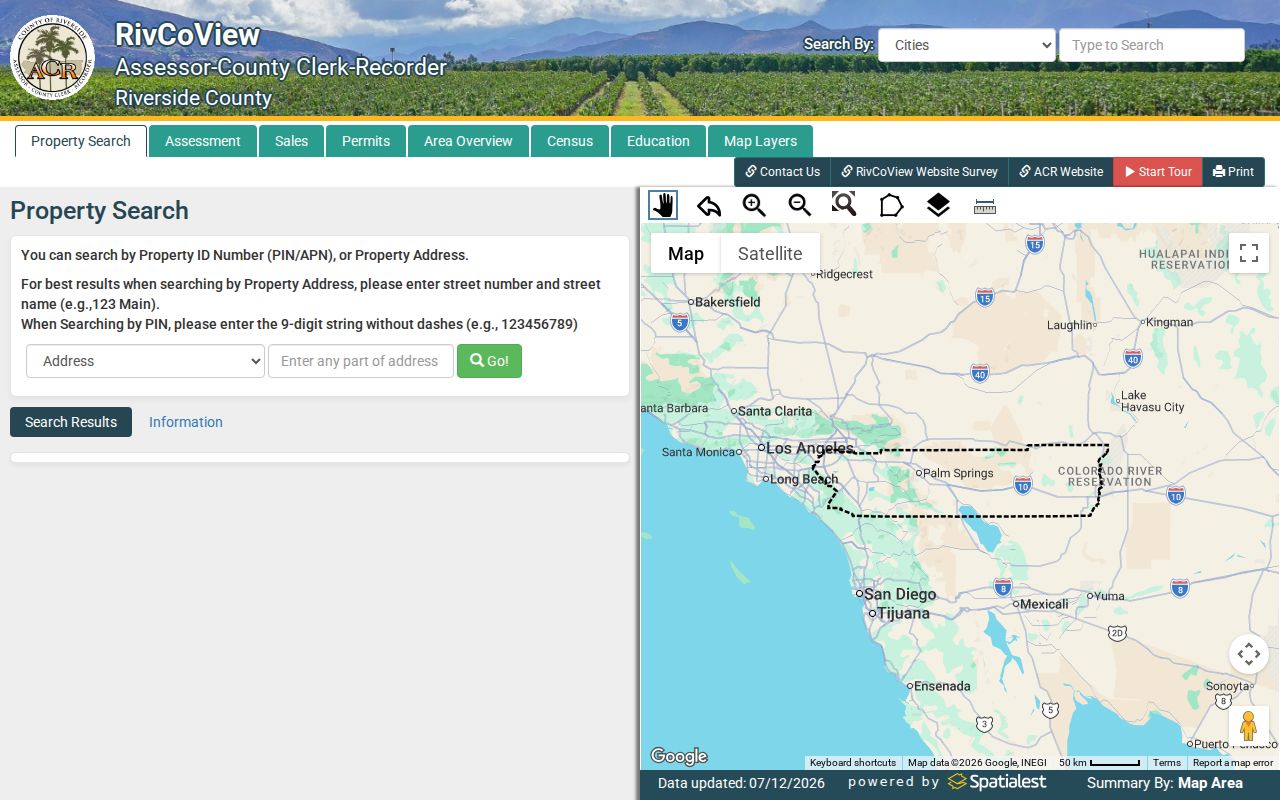
The portal is the practical bridge between a street address, its parcel number, recent sales, and recorded-document research. Assessor maps add lot lines, dimensions, acreage, street widths, adjoining parcels, and recorded map references, but they do not show ownership or street addresses. Use a map for parcel geometry, then pair its APN with RivCoView or the assessor result.
Map limit. A parcel map is not an ownership record. Confirm the APN in assessor data, then use the recorder index for the document chain.
Palm Desert Court Records Access
Riverside Superior Court serves Palm Desert, with Larson Justice Center in Indio and the Palm Springs Courthouse among the nearby access points. The Public Access portal requires an account. A case-number search is free when the needed details are known, but searches by a person or organization name use paid credits. A selected case can display a Register of Actions, the chronological list of filed documents, their dates, and the filing party.
Online data is not the official court record. California Rules of Court limit remote access, and confidential or sealed material may not appear. Name-search results identify case numbers and filing dates; document downloads cost $1 per page for the first five pages, then $0.50 per additional page, capped at $50 per document. Certified copies use court form RI-MC011 through eSubmit, or a mail or drop-box request to the right courthouse with payment and a stamped return envelope.
Can every Palm Desert case file be read online? No. Juvenile, adoption, sealed, protected, and many family-related documents remain restricted, and even a visible case entry may offer no downloadable filing.
Palm Desert Vital Records Copies
Births, deaths, and marriages tied to Riverside County use several channels. Riverside University Health System registers recent births and deaths. Riverside ACR issues county certificates, generally after records reach its system, and the California Department of Public Health is the statewide fallback. An authorized certified copy can establish identity or legal facts. An informational copy carries a warning and cannot establish identity. The county's vital-certificate instructions show the application choices and current county process.
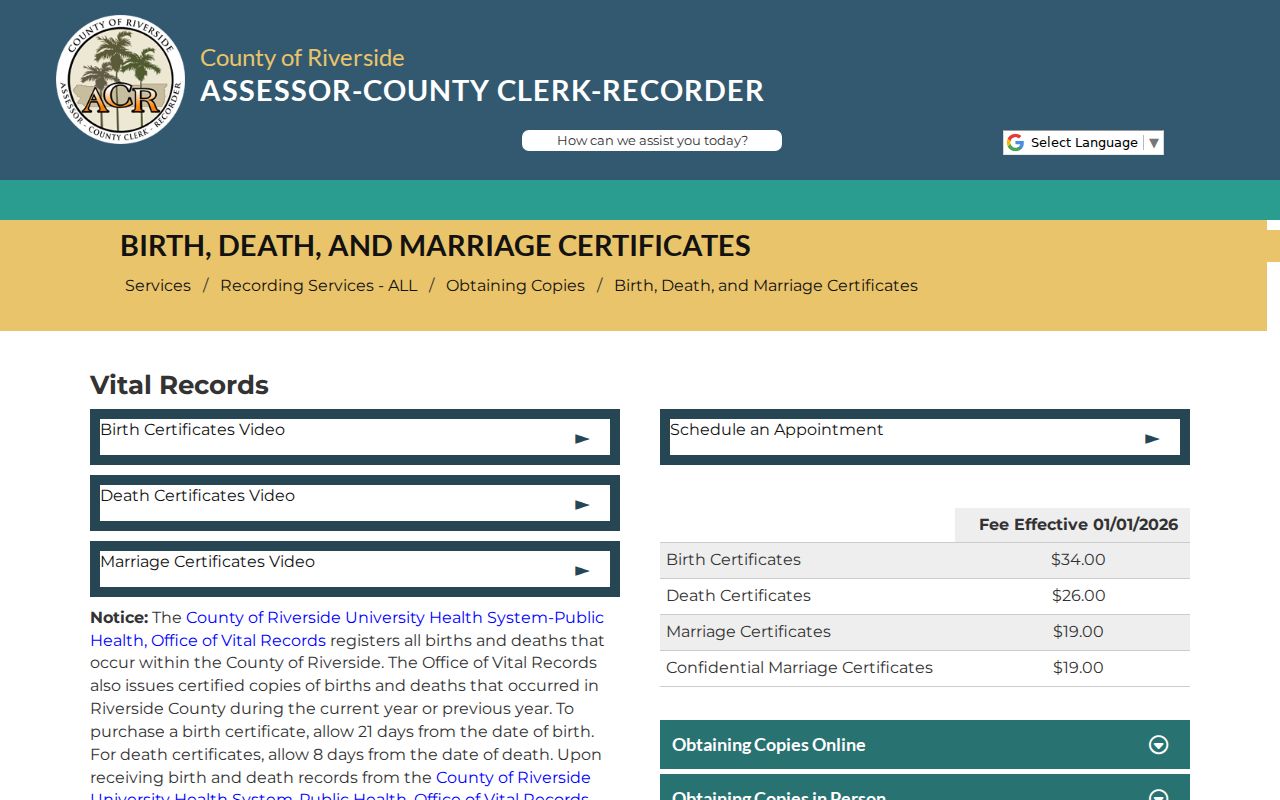
The screen matters because certificate access depends on both the record type and the requested copy type. Health and Safety Code section 103526 limits authorized copies to verified statutory categories. A confidential marriage certificate is narrower still: it goes to a party to the marriage unless a court orders release. For online ordering, Riverside eVitals handles identity verification and order intake.
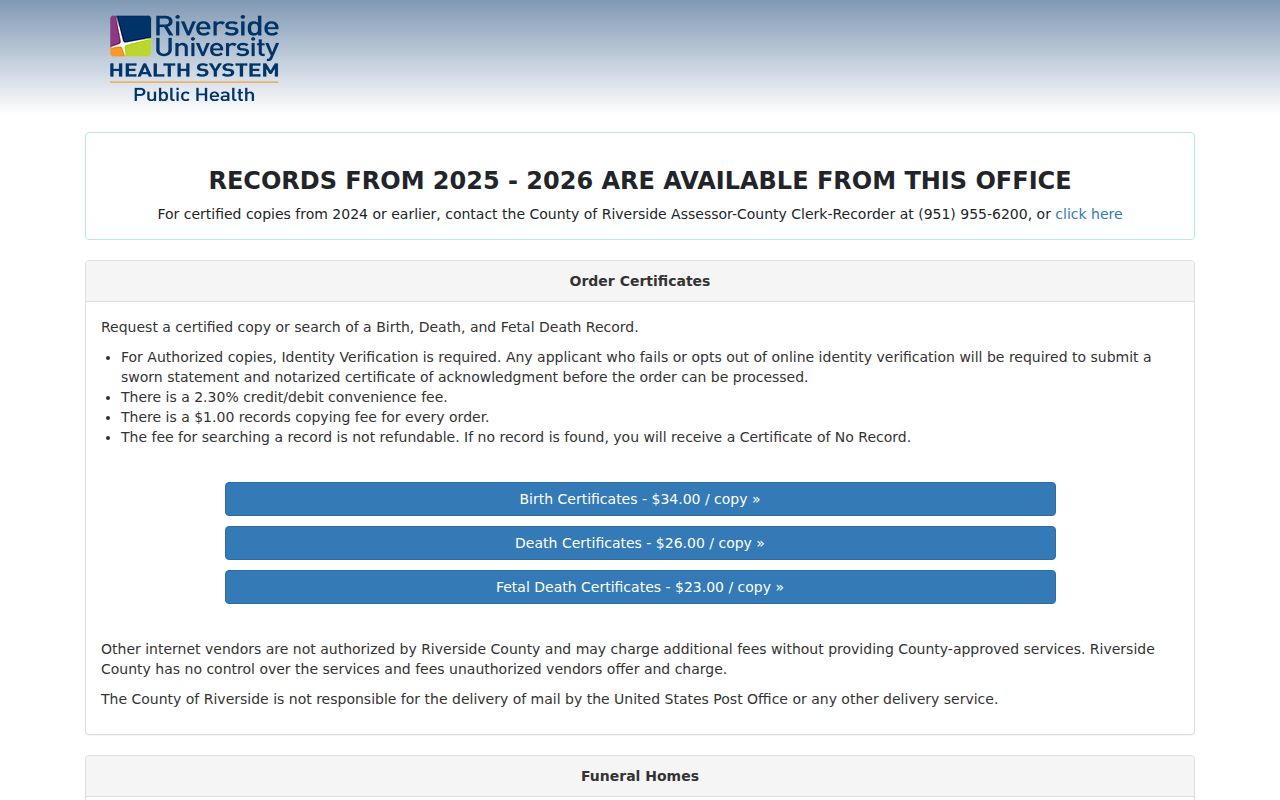
Applicants who cannot complete online identity verification may need a sworn statement and notarized acknowledgment. In-person orders require government-issued identification for authorized copies. Mail orders use the county application and check or money order, with no cash, temporary checks, or third-party checks.
Palm Desert Records Custodians and Portals
Custody follows the government work that produced the file. Palm Desert City Clerk handles city records and coordinates city Public Records Act requests. Riverside ACR combines official recording, county clerk, vital certificate, assessment, map, fictitious-business-name, and archive functions. Riverside Superior Court controls its case records. Sending a broad request to the wrong office adds delay because the office need not obtain records held elsewhere.
Palm Desert City Clerk
73510 Fred Waring Drive
Palm Desert, CA 92260
(760) 776-6402
Riverside County ACR
38686 El Cerrito Road
Palm Desert, CA 92211
(760) 863-8732
Official, clerk, property, and archive channels
Larson Justice Center
46-200 Oasis Street
Indio, CA 92201
(760) 393-2617
Nearby court clerk and copy access
For non-posted municipal files, the City Clerk routes requests through Palm Desert's GovQA intake. For an older county record, a certified court file, or a vital certificate, use the custodian's own copy path instead of treating every need as a CPRA request.
Palm Desert Custody Record Lookups
County jail, state prison, and court systems answer different questions. The Riverside County Sheriff's Inmate Information System is a current-custody lookup. Last name is mandatory. First name and date of birth are optional, and date of birth can help separate common names. A booking lookup does not replace a court docket, and a court filing does not prove that a person remains in custody.
The Riverside inmate information search provides the county booking route.
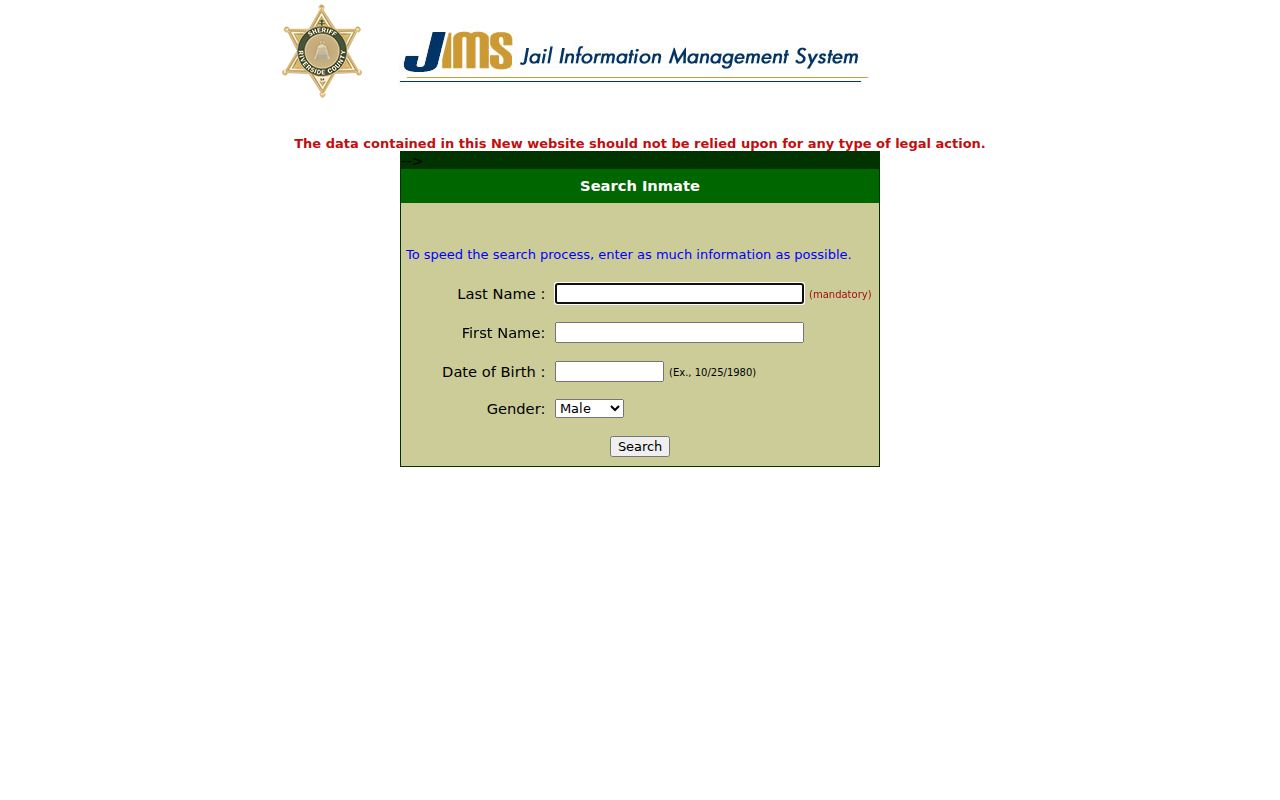
Use California CIRIS for state prison custody. If a common name prevents a match, CDCR guidance directs callers to its ID Unit and says a date of birth will be required. The Megan's Law registry is separate and shows only information that California law permits to be disclosed. It is a public-safety registry, not a full criminal-history search.
Palm Desert Records Before the Web Index
The inspected recorder search stated that recorder documents begin January 1, 1974. Yet the county copy page says office computers search back to 1975 and directs 1974-and-earlier work to Gateway Riverside. Those statements describe different access points, not proof that earlier records vanished. For an older deed, use the web index first, then office computers, and finally the Gateway Riverside location when the year falls outside the office system.
Riverside County was organized in 1893, and clerk, land, marriage, birth, and death holdings reach into that county era. Palm Desert incorporated in 1973. Earlier residents may appear under Palm Springs, Indio, Rancho Mirage, Indian Wells, or broader Coachella Valley and county records. The California State Archives holds selected county and city records on original media or microfilm, though some groups lack a name index. Riverside County Archives is another fallback when a modern portal cannot surface historical county material.
Note: An online cutoff marks the index's reach, not the full age of the custodian's paper, microfilm, or archived holdings.
Closed and Redacted Palm Desert Records
Open-records law works beside statutes and court rules that protect privacy or safety. Common closed or redacted categories include sealed court matters, juvenile and adoption files, confidential victim or witness details, Social Security numbers, financial account numbers, protected addresses, confidential marriages, and voter data outside approved purposes. DMV personal information is restricted by federal law. A visible index entry does not override these rules.
- Index
- A finding aid with names, dates, numbers, or record types. It may not include the underlying image.
- Certified copy
- An official copy authenticated by the custodian for uses that require proof.
- Custodian
- The office that keeps and responds for the requested government record.
- Exemption
- A legal basis that allows or requires an office to withhold all or part of a record.
When an office withholds material, ask it to identify the exemption and release any segregable, non-exempt portion. Narrowing a request by date, department, address, document type, or known file number often makes review faster without seeking protected details.
Palm Desert Record Copy Fees
Fees depend on both the custodian and the product. An index search can be free while its document image, certification, or certificate costs money. Riverside ACR charges $8 for the first page of an official-record copy, $1 for each added page of that document, and $2 to certify a document. The county says an online official-record order averages 48 hours to process and adds a 2.15 percent card fee.
| Copy or Search | Verified Fee |
|---|---|
| Official-record copy | $8 first page; $1 each additional page |
| Official-record certification | $2 per document |
| Riverside birth certificate | $34 in 2026 |
| Riverside death certificate | $26 in 2026 |
| Public or confidential marriage certificate | $19 in 2026 |
| Court document download | $1 per page for first five; $0.50 after; $50 document cap |
The county's official-record copy instructions show the web, mail, drop-box, and counter channels together.
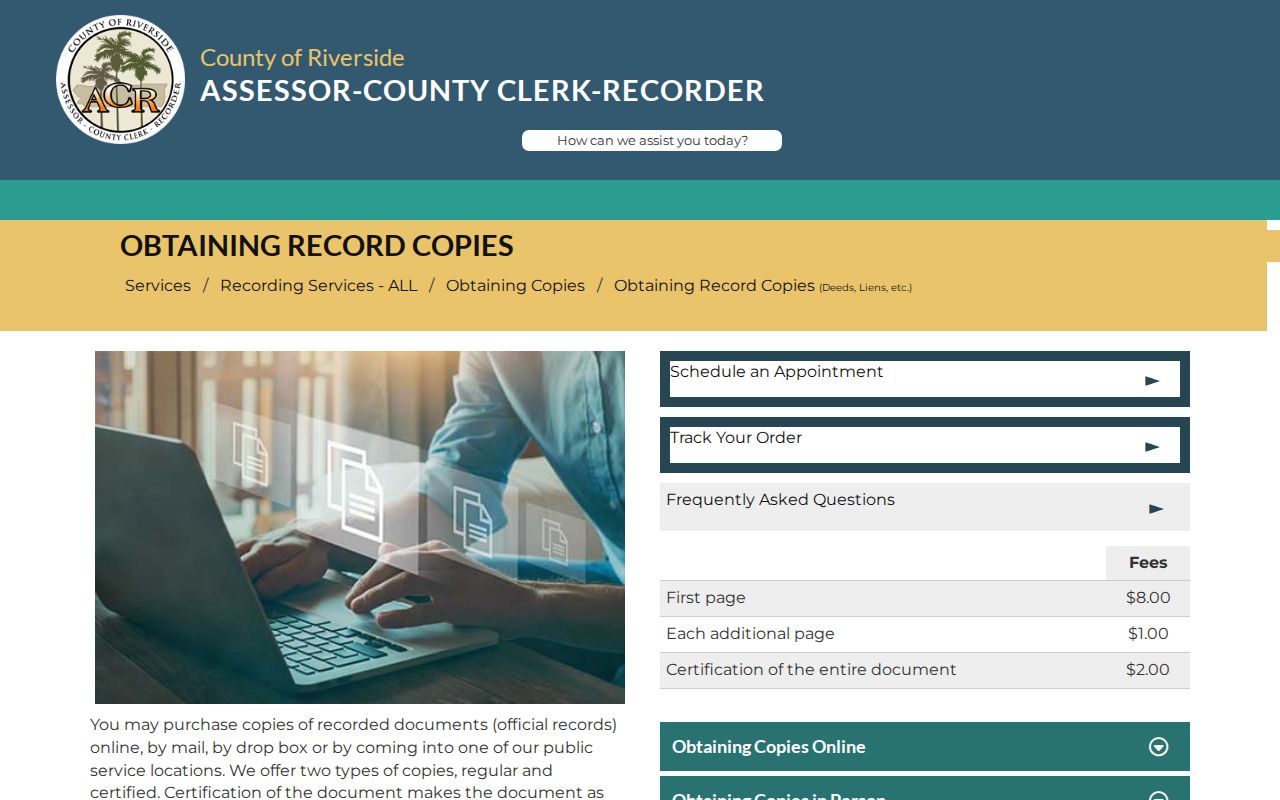
That source is also the best check against overpriced deed-copy mailers. Riverside County warned residents in 2026 about mail seeking payment for public property documents. Verify the document and fee with ACR before paying a private solicitation.
California DROP and Palm Desert Records
California's Delete Request and Opt-out Platform, called DROP, launched January 1, 2026. It lets eligible California residents send one deletion request to hundreds of registered data brokers. Brokers begin processing requests on August 1, 2026 and then repeat deletion work every 45 days under the state program.
DROP does not erase Palm Desert public records from the City Clerk, recorder, assessor, or court. It addresses broker-held copies and commercial data. Government records remain governed by their own retention, correction, sealing, redaction, and confidentiality rules. Safe at Home and election confidentiality can protect qualifying addresses, while vital and court access limits protect other sensitive information.
Request Palm Desert Public Records
Use the most specific channel available. A CPRA request is best for an existing, non-posted city or agency record. It is not the right substitute for a recorder copy order, court certification, or vital certificate application. California agencies generally make an initial determination within 10 days and may extend that period by up to 14 days in unusual circumstances. That determination is not always the delivery date.
- Name the custodian. Send city business to Palm Desert, recorded and assessor files to Riverside ACR, and case files to the court.
- Check the public index. Save a document number, case number, APN, date, or exact title when one appears.
- Describe an existing record. Give a date range, department, address, subject, and known identifier. Do not ask the office to create a new report.
- Choose the proper delivery path. Use portal, email, mail, counter, drop box, or custodian form as that office directs.
- Review cost and scope. Ask for electronic copies when available and narrow an overly broad request before paying.
- Address any withholding. Request the cited exemption and any non-exempt part that can be separated and released.
Lawful personal use. Palm Desert records may support family history, estate research, property review, and civic oversight. Never use a record to stalk, harass, intimidate, or harm anyone.
Note: A focused request with the right custodian and a known identifier is easier to process than a demand for every mention of a person.